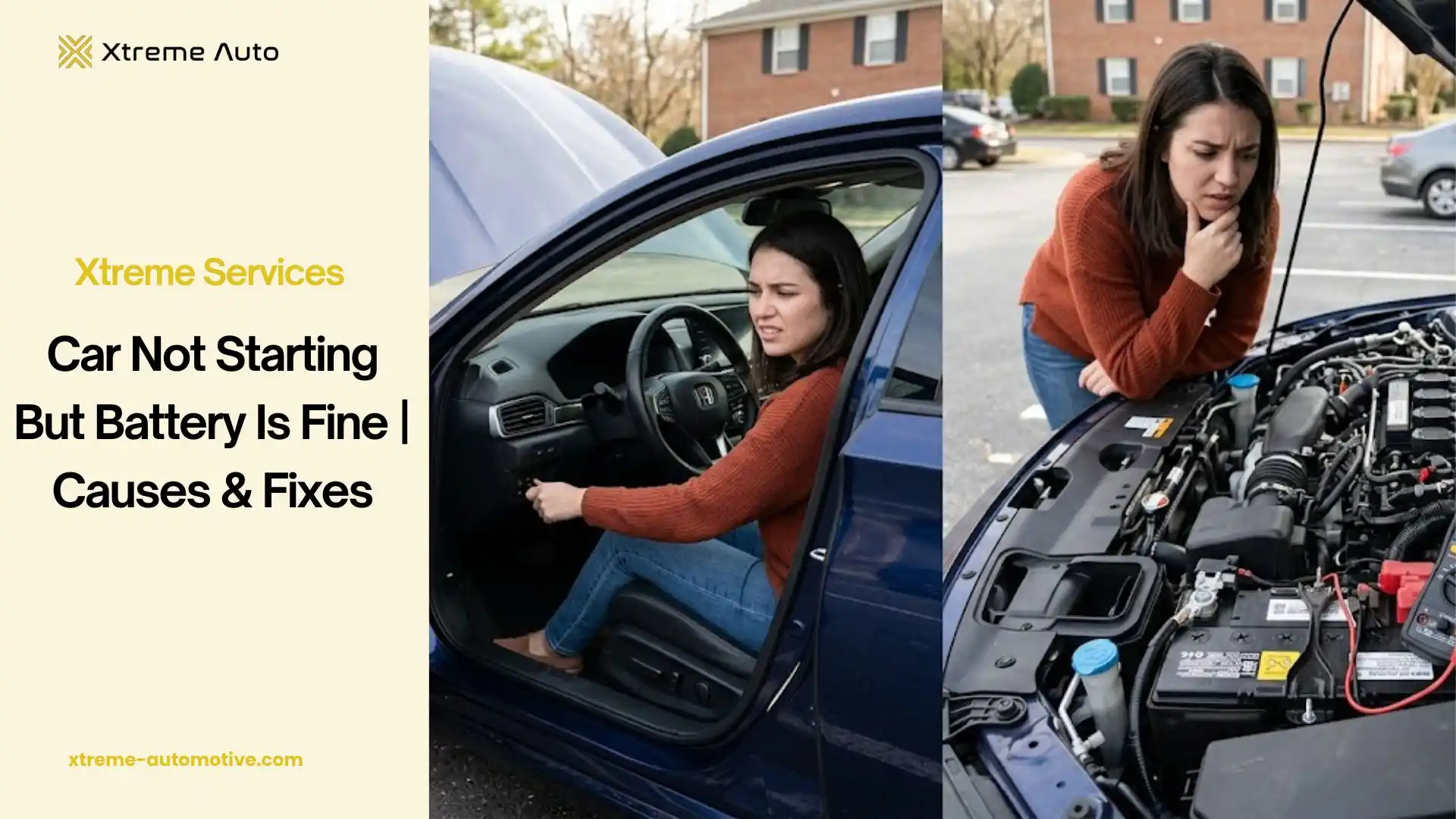
You turn the key and nothing happens. The dashboard lights up, the radio works, and the battery you checked last week reads perfectly fine
You turn the key and nothing happens. The dashboard lights up, the radio works, and the battery you checked last week reads perfectly fine. Yet the car still won't move. If your car is not starting but battery is fine, you're not alone, and the battery is almost never the whole story. There are several parts that sit between the battery and a running engine, and any one of them can fail quietly while the battery looks completely healthy. This guide walks you through the most common causes, what to listen for, and when it's time to bring the car in for a proper check.
Why Car Is Not Starting Even When the Battery Is Fine
When the battery is working properly, the issue usually comes from other key components in the starting system.
1. The Starter Motor
The starter motor is what physically turns the engine over when you press start. When it fails, you'll usually hear one of two things: a single loud click with no crank, or a grinding noise as the gear struggles to engage the flywheel. In some cases there's no sound at all.
One quick field test: tap the starter motor body firmly with a wrench. If the car starts after that, the motor's internal parts are sticking, which means it's worn and needs replacing soon. A voltage drop test done by a technician can confirm this with more precision.
A car not starting but battery is fine scenario often points straight to the starter motor, especially on vehicles with higher mileage.
2. The Ignition Switch
The ignition switch sends the signal that puts everything in motion. If it wears out, the battery stays charged, the lights stay on, but nothing happens when you turn the key.
The tricky part is that ignition switch failure is often intermittent at first. The car might start fine three times in a row and then refuse on the fourth try. Other signs include dashboard lights flickering or cutting out briefly as you turn the key or the engine dying unexpectedly while driving.
Heavy keychains are a known contributor here. The constant weight they put on the ignition cylinder gradually wears down the switch's internal contacts over time.
3. The Fuel Pump
A car not starting but battery is fine can also come down to the fuel system. If the fuel pump fails, no fuel reaches the engine, so the engine cranks but never actually fires. You'll hear the engine turning over without catching.
Listen for a faint hum or whine from the rear of the car when you first turn the key to the "on" position before cranking. That sound is the fuel pump priming the system. If you hear nothing, the pump may already be dead.
A clogged fuel filter can cause the same result by blocking fuel flow before it reaches the injectors.
4. The Alternator
This one trips up a lot of drivers. The alternator is what keeps the battery charged while the engine runs. If the alternator fails, the battery drains slowly across every trip until there's not enough charge left to start the car, even though the battery itself is structurally fine.
The clearest sign of an alternator problem is needing a jump start more than once, or buying a new battery that dies within a few weeks. If your car only starts with a jump, suspect the alternator before the battery.
5. Corroded or Loose Battery Terminals
The battery could be fully charged and still cause a no-start if the cables connecting it aren't making good contact. Corrosion on the terminal posts creates resistance that blocks current from reaching the starter.
Check both terminals for white or bluish-green buildup. If you find it, clean it off with a wire brush and make sure the clamps are clamped down tight. This is a five-minute job that sometimes fixes what looked like an expensive problem.
A healthy battery at rest should read around 12.6 volts. Consistently under 12 volts means the charging system needs attention.
6. A Blown Fuse
A single blown fuse in the right circuit is enough to keep the car from starting. Some power will still be present, the lights might work, the radio might play, but the engine circuit stays dead.
Find your car's fuse box location in the owner's manual and look for any blown fuses related to the ignition or starter circuits. A multimeter will confirm whether current passes through each one. Fuses are cheap, but if the same fuse blows again after replacement, there's a bigger electrical fault behind it.
What the Sounds Are Telling You
The noise you hear when you turn the key gives you a strong starting point for diagnosis:
Rapid clicking, fast and repeated, usually points to low battery voltage even if the battery tested fine or a bad connection at the terminals.
A single click with no crank is more likely to be the starter solenoid or the starter motor itself.
Complete silence, no sound at all, often points to a blown fuse, a bad ignition switch, or a fully broken electrical circuit.
"Engine cranks but never fires" points toward the fuel pump, fuel filter, or in some cases the ignition system's spark delivery.
When your car is not starting but battery is fine, what you hear narrows down the list considerably before any tools are involved.
What You Can Check Before Calling a Mechanic
Start by looking at the battery terminals for corrosion or looseness. Then check the fuse box for any obviously blown fuses. Try a jump start, not because the battery is necessarily dead, but to rule it out entirely.
Pay attention to any dashboard warning lights that stay on when you try to start, particularly the oil pressure light, the battery warning, or any security/immobilizer indicator. These can point directly to which system is causing the problem.
Note the pattern too. If the car refused to start only once and has been fine since, that's different from a car that fails every time or only when the engine is warm.
Car Not Starting But Battery Is Fine? Get the Real Answer at Xtreme Service
When your car is not starting but the battery is fine, the issue is usually deeper than what a basic check can reveal. At Xtreme Service, we don’t rely on guesswork—we perform full electrical and mechanical diagnostics to find the exact cause quickly and accurately, using advanced tools and expert technicians.
We handle all vehicle types—manual, automatic, and electric—and cover every possible system that could affect starting performance, so you don’t waste time moving between different workshops.
Why Xtreme Service is your best choice for starting issues
- Full computerized diagnostics to identify the exact reason your car won’t start
- Starter motor testing to ensure proper engine cranking function
- Alternator and charging system checks to rule out power flow issues
- Ignition system inspection for spark and combustion problems
- Fuel system evaluation to detect delivery or pressure faults
- Complete electrical system analysis for hidden or intermittent faults
- Mechanical wear inspection that may affect engine starting performance
- Comprehensive service for all vehicle types: manual, automatic, and electric
More than just a quick fix
- Full periodic maintenance and preventive inspection services
- Engine oil change and lubrication system checks
- Brake and transmission services for safe driving performance
- Air conditioning and electrical repair services
- Bodywork and accident repair solutions under one roof
- Specialized expertise in Nissan, Volkswagen, Audi, SEAT, and Škoda
- Service available for all other car brands with the same quality standards
At Xtreme Service, we don’t just fix symptoms—we identify the real problem behind the car not starting but battery is fine issue and give you a clear, honest solution without unnecessary repairs or parts replacement.
Don’t wait until the problem gets worse or leaves you stranded. If your car is not starting but the battery is fine, book your full diagnostic check today at Xtreme Service and get a fast, accurate answer from experts you can trust.
Call us now or message on WhatsApp, or book online through xtreme-automotive.com and get your car checked today.
FAQs
Can the car's anti-theft system stop it from starting even with the right key?
Yes. If the immobilizer doesn't recognize the key's transponder signal, it will cut the engine circuit completely. The car may crank without firing, or give no response at all. A reprogrammed or replacement key solves it, but the diagnosis needs to confirm that's the actual cause first.
Why does the car start in the morning but not after a short drive?
Heat is usually behind this. Some starters and relays work fine when cold but fail once they reach operating temperature. The car starts fine after cooling overnight, but not right after a short trip. If this happens consistently, the starter or a heat-sensitive relay is the most likely cause.
Could the gear selector position be the reason the car won't start?
On automatic vehicles, yes. The car won't start unless the gear selector is in Park or Neutral. A faulty neutral safety switch can also cause this, making the car think it's not in the right gear even when it is.
Is it safe to keep attempting to start the car when it won't turn over?
Repeated failed attempts can drain the battery and put extra strain on the starter motor. If the car doesn't start after two or three tries, stop and diagnose before continuing. Holding the key in the start position for extended periods can also burn out the starter.
Can bad spark plugs cause a car not starting but battery is fine situation?
Worn or fouled spark plugs won't prevent the engine from cranking, but they can stop it from firing. If the engine turns over at normal speed but never catches and the fuel system checks out, the ignition system, including spark plugs, ignition coils, and wires, is worth inspecting next.
