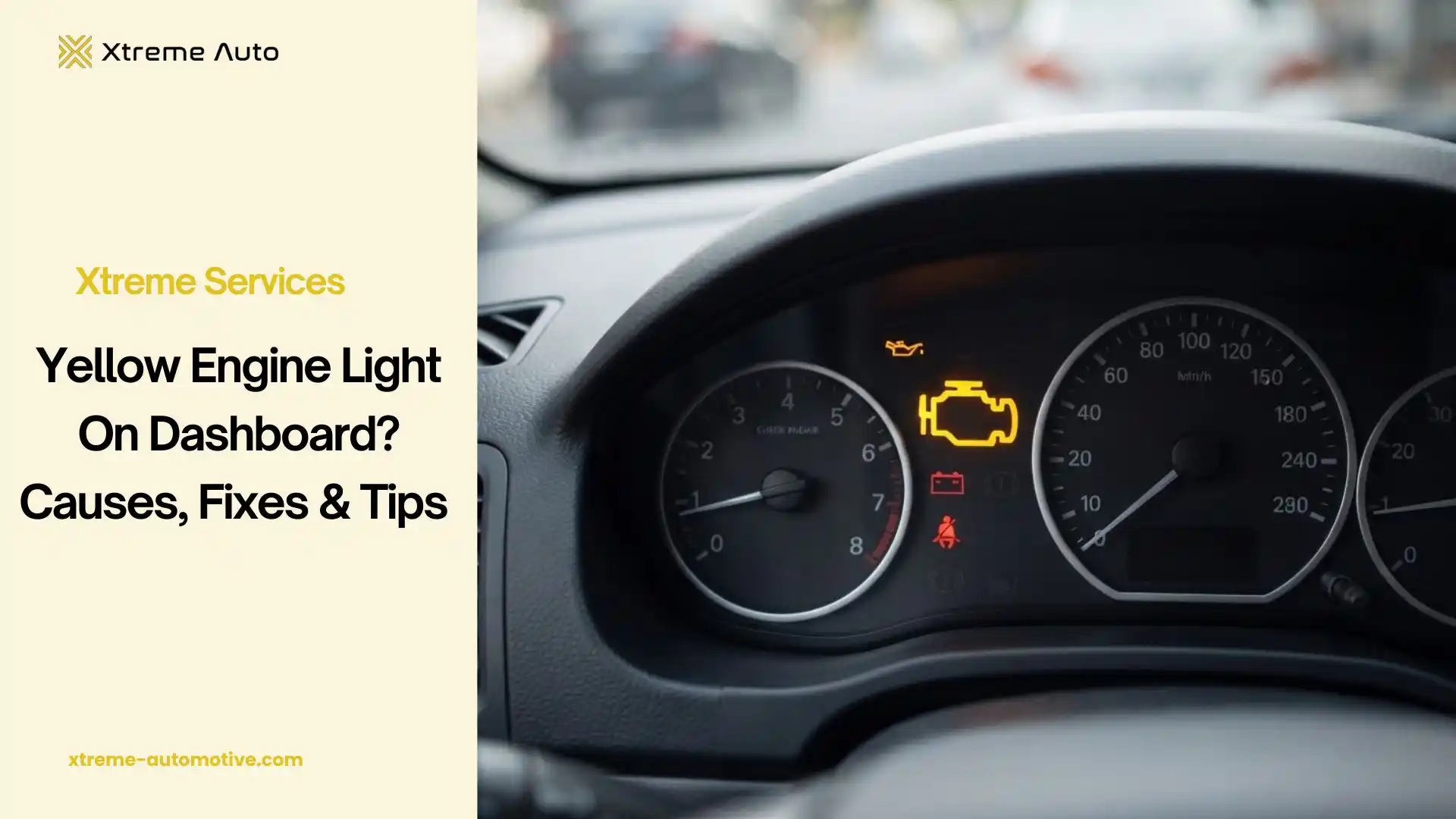
Seeing a yellow engine light on dashboard can be worrying, especially when your car appears to be driving normally
Seeing a yellow engine light on dashboard can be worrying, especially when your car appears to be driving normally. However, the yellow Check Engine Light, also known as the Malfunction Indicator Lamp (MIL), does not automatically mean that your engine has suffered major damage.
Instead, the warning means that the vehicle's onboard diagnostic system has detected a fault that requires further investigation. Depending on the vehicle and the stored diagnostic trouble code (DTC), the issue could involve the ignition system, engine sensors, fuel system, air-fuel mixture, emissions system, wiring, or another monitored component.
The important point is that the yellow engine light is a warning, not a complete diagnosis. Reading the diagnostic codes and inspecting the vehicle are necessary to determine the actual cause. Chevrolet, for example, describes the Check Engine Light as an indication that the vehicle has detected a malfunction involving the engine or propulsion system and recommends servicing the vehicle when the light appears.
What Does the Yellow Engine Light on Dashboard Mean?
The yellow engine light on dashboard is commonly referred to as the Check Engine Light, engine warning light, or Malfunction Indicator Light (MIL).
It is part of the vehicle's onboard diagnostics system, which monitors various engine and emissions-related components. When the system detects a condition outside the expected parameters, it can store a diagnostic trouble code and illuminate the warning light.
The light itself does not identify the failed component. The same warning symbol can be triggered by different problems, including:
- Faulty spark plugs or ignition coils
- Engine sensor problems
- Fuel injection or fuel-system issues
- Air-fuel mixture problems
- Oxygen sensor faults
- Emissions-system problems
- Catalytic converter-related faults
- Electrical or wiring problems
- Certain engine performance problems
Modern vehicles monitor numerous systems through onboard diagnostics, including misfire, fuel, oxygen sensor, catalyst, and other component monitors.
In simple terms: a yellow engine warning light means that the vehicle has detected a problem that needs to be diagnosed. It does not, by itself, tell you which part needs to be replaced.
Why Does the Yellow Engine Light Come On?
There are many possible reasons for a Check Engine Light, and the exact cause varies by vehicle, engine, mileage, and operating conditions.
Some of the most common causes include:
1. Faulty Spark Plugs or Ignition Coils
A problem with the ignition system can cause incomplete combustion or an engine misfire. When the engine does not ignite the air-fuel mixture correctly, the vehicle may record a misfire-related fault and illuminate the Check Engine Light.
You may also notice:
- Engine shaking or vibration
- Rough idling
- Poor acceleration
- Difficulty starting
- Increased fuel consumption
- Loss of engine power
A faulty ignition component can therefore produce both a warning light and noticeable drivability symptoms. Manufacturer information also shows that ignition-related faults can be associated with engine misfires, reduced fuel economy, and an illuminated Check Engine Light.
However, replacing spark plugs or ignition coils simply because the light is on is not always the correct solution. The diagnostic process should identify the affected cylinder or ignition circuit before parts are replaced.
Professional tip: If the engine is misfiring, diagnosis should come before replacing ignition components at random.
2. Faulty Engine Sensors
Modern engines depend on sensors to provide information to the engine control unit (ECU). If a sensor produces an incorrect signal, loses communication, or has a wiring problem, the Check Engine Light may appear.
Possible examples include:
- Oxygen sensor
- Mass airflow sensor (MAF)
- Manifold absolute pressure sensor (MAP)
- Crankshaft position sensor
- Camshaft position sensor
- Coolant temperature sensor
- Other emissions-related sensors
For example, a faulty camshaft position sensor can cause starting or intermittent engine-running problems, while the Check Engine Light may also illuminate.
However, a diagnostic code associated with a sensor does not necessarily mean that the sensor itself is defective. The problem could be caused by:
- Damaged wiring
- Loose connectors
- Poor electrical connections
- Incorrect sensor readings
- A related mechanical problem
- An issue with the ECU or another component
This is why replacing a sensor without testing the associated circuit can result in unnecessary repair costs.
3. Fuel System or Air-Fuel Mixture Problems
The engine needs the correct balance of air and fuel to operate efficiently. Problems affecting fuel delivery or air measurement can trigger the Check Engine Light.
Possible causes include:
Fuel injector problems
Air intake leaks
Incorrect airflow readings
Fuel pressure problems
Fuel mixture that is too rich or too lean
Problems with related sensors
Symptoms may include rough running, hesitation during acceleration, reduced fuel economy, or difficulty starting.
The diagnostic code can help identify the system that requires attention, but additional testing may still be necessary to determine the actual source of the problem.
4. Exhaust and Emissions System Problems
The yellow engine light on dashboard can also be associated with the vehicle's emissions-control system.
- Possible causes include:
- Oxygen sensor problems
- Catalytic converter-related faults
- Exhaust leaks
- Emissions-system component failures
- Air-fuel mixture issues
- Other monitored emissions faults
The onboard diagnostic system monitors several emissions-related components, including oxygen sensors and catalyst efficiency.
It is important to distinguish between an unusual exhaust sound and an illuminated Check Engine Light. An exhaust leak may create a noticeable noise, while the warning light could be caused by a separate issue—or both problems may be related.
A catalytic converter should also not be diagnosed solely from the warning light. The stored codes, live data, engine symptoms, and physical inspection should be considered together.
What Is the Difference Between a Steady and Flashing Yellow Engine Light?
The way the yellow engine light on dashboard behaves can help indicate the urgency of the situation.
| Check Engine Light Status | What It May Indicate | Recommended Action |
| Steady yellow light | A fault has been detected and stored | Arrange a diagnostic inspection |
| Flashing yellow light | A serious active misfire may be occurring | Reduce driving and seek service promptly |
| Light disappears | The fault may be intermittent | Do not assume the issue is permanently fixed |
| Light + shaking or power loss | A significant engine or drivability problem may be present | Have the vehicle inspected as soon as possible |
A flashing malfunction indicator can be particularly important. EPA regulations specify that the MIL must blink when an engine misfire is occurring under conditions where catalyst damage is imminent.
Chevrolet also recommends service as soon as possible when the Check Engine Light appears and indicates that service is more urgent when the light is flashing or drivability changes occur.
Important: If the engine light is flashing and the vehicle is shaking, misfiring, or losing significant power, avoid treating the warning as a normal maintenance reminder. Have the vehicle checked promptly.
Can a Yellow Engine Light Appear Without Any Noticeable Symptoms?
Yes. A vehicle can illuminate the Check Engine Light even when the driver does not notice a change in performance. Some faults are detected electronically before they create obvious drivability symptoms.
This means you should not assume that the car is fine simply because:
- The engine sounds normal
- The car accelerates normally
- Fuel consumption appears unchanged
- There are no unusual noises
- The warning light is steady rather than flashing
Chevrolet notes that a Check Engine Light may appear before noticeable engine or propulsion-system problems occur while driving.
A diagnostic scan can therefore be useful even when the vehicle appears to be operating normally.
How Is the Cause of a Yellow Engine Light Diagnosed?
Professional diagnosis should go beyond simply connecting a scanner and reading the code.
The correct approach is to identify the stored diagnostic trouble code (DTC), interpret it in the context of the vehicle, evaluate the symptoms, inspect related components, and perform additional tests when necessary.
Step 1: Read the Diagnostic Trouble Codes
A diagnostic scanner is connected to the vehicle's diagnostic port to retrieve stored fault codes.
These codes provide valuable information about the system or circuit where the vehicle detected an abnormal condition.
Step 2: Interpret the Code
A code is a diagnostic direction—not necessarily a confirmation that one specific part is defective.
For example, a sensor-related code may require checking the sensor, wiring, connector, power supply, ground, and related engine conditions.
Step 3: Review the Vehicle's Symptoms
The technician should consider symptoms such as:
- Engine misfire
- Rough idle
- Poor acceleration
- Engine vibration
- Difficult starting
- Reduced fuel economy
- Unusual noises
- Loss of power
- Limp Mode
Combining the diagnostic data with the driver's description can help narrow down the potential cause.
Step 4: Inspect Related Components
Depending on the fault, the technician may inspect:
- Spark plugs
- Ignition coils
- Sensors
- Fuel injectors
- Fuel system
- Wiring and connectors
- Air intake
- Exhaust system
- Emissions components
- Engine-related components
Step 5: Perform Additional Tests
If the initial scan does not identify the exact cause, additional electrical, mechanical, or live-data testing may be required.
This is an important part of professional diagnosis because replacing components based only on a fault code can lead to unnecessary repairs.
Step 6: Repair the Root Cause and Recheck the Vehicle
After the underlying problem has been repaired, the vehicle should be checked again to confirm that the fault has been addressed and that related symptoms or codes have not returned.
The key principle is simple: scan → interpret → test → repair → recheck.
Does Clearing the Check Engine Light Fix the Problem?
No. Clearing a diagnostic code is not the same as repairing the fault.
A scanner may be able to erase stored codes and turn off the yellow engine light on dashboard, but if the underlying problem remains, the warning can return when the vehicle's diagnostic system detects the same condition again.
This is why clearing the light without investigating the cause is not a reliable repair strategy.
A proper repair sequence should be:
Read the code → diagnose the cause → repair the fault → rescan the vehicle → confirm the result.
Some vehicle systems can also turn the light off automatically after certain fault conditions are no longer detected over subsequent driving cycles, which means a light that disappears does not necessarily prove that the original problem has been permanently resolved. EPA OBD regulations describe conditions under which the MIL can be extinguished after the relevant monitoring system no longer detects the fault.
When Should You Get a Yellow Engine Light Checked Immediately?
Not every Check Engine Light situation has the same level of urgency. However, certain symptoms should make you seek professional inspection quickly.
Pay particular attention if the yellow engine light on dashboard appears together with:
- A flashing Check Engine Light
- Severe engine shaking
- Noticeable misfiring
- Significant loss of power
- Severe difficulty starting
- Unusual fuel smell
- Engine overheating
- Abnormal mechanical noises
- Limp Mode or reduced-power operation
- Major changes in vehicle performance
A steady warning light with no noticeable symptoms still deserves diagnosis, but a flashing light or major drivability change should be treated with greater urgency.
Can You Drive With the Yellow Engine Light On?
It depends on how the vehicle is behaving and whether the light is steady or flashing.
If the light is steady and the vehicle is operating normally, the situation may not require an immediate stop in every case, but the fault should still be diagnosed rather than ignored.
If the light is flashing, especially when accompanied by shaking, misfire, loss of power, or other serious symptoms, continued driving can increase the risk of damage. EPA requirements specifically associate flashing MIL operation with certain misfire conditions where catalyst damage is imminent.
Always follow your vehicle manufacturer's recommendations and seek professional assistance when the warning is accompanied by significant changes in vehicle behavior.
Why You Should Not Replace Parts Based Only on the Check Engine Light
One of the most common diagnostic mistakes is assuming that the component mentioned by a fault code must automatically be replaced.
For example, if a scan identifies a sensor-related code, the actual problem could be:
- The sensor itself
- Wiring
- A connector
- Electrical power or ground
- An incorrect signal
- Another component affecting the sensor reading
- A mechanical issue
The same principle applies to ignition, fuel, and emissions-related codes.
A diagnostic scanner identifies where to investigate; professional testing determines what actually needs repair.
This approach can help prevent unnecessary parts replacement and ensures that the repair addresses the root cause rather than temporarily hiding the symptom.
Where Can You Check a Yellow Engine Light in Egypt?
If your yellow engine light on dashboard appears and you cannot determine why, it is best to visit a service center equipped for electronic diagnostics and capable of combining scan results with physical inspection.
Xtreme Service, part of Xtreme Automotive, provides vehicle inspection, maintenance, repair, and electronic diagnostic services. Its published service information highlights modern diagnostic equipment and technical expertise for identifying vehicle faults.
The Xtreme Service center is located on the Ring Road in front of CFC and provides maintenance and diagnostic services for different vehicle makes. Xtreme's published information specifically lists Nissan, Volkswagen, SEAT, Skoda, and Audi among the brands it specializes in, while also stating that it services other brands and vehicle categories.
Why Choose Xtreme Service for Check Engine Light Diagnosis?
When the yellow engine light on dashboard comes on, the priority should be finding the underlying cause rather than simply turning the warning off.
Xtreme Service's published information highlights services including:
- Electronic vehicle diagnostics
- Engine diagnostics and repair
- Sensor diagnosis
- Electrical and electronic fault repair
- Fuel and ignition system inspection
- Periodic and preventive maintenance
- Battery and electrical system checks
- Gearbox inspection and maintenance
- Air-conditioning services
The center also states that it uses modern diagnostic equipment and trained technicians to support vehicle inspection and repair.
How Does Xtreme Service Diagnose a Check Engine Light?
The diagnostic process can begin by understanding the symptoms the driver has noticed and then reading the vehicle's stored diagnostic information.
The process may include:
1. Identifying the symptoms
The technician considers whether the vehicle is experiencing shaking, hesitation, poor acceleration, difficult starting, unusual noises, or reduced performance.
2. Electronic diagnostic scan
Diagnostic equipment is used to read stored codes and relevant vehicle data.
3. Identifying the system requiring investigation
The results can help determine whether further inspection should focus on ignition, fuel, sensors, electrical systems, emissions, or another vehicle system.
4. Physical inspection
The diagnostic scan is combined with inspection of the relevant components, wiring, connectors, and other systems.
5. Determining the correct repair
Depending on the findings, the vehicle may require adjustment, cleaning, repair, or replacement of a defective component.
6. Rechecking the vehicle
After the repair, the vehicle can be checked again to verify that the underlying issue has been addressed.
Xtreme Service's published material similarly emphasizes using diagnostic equipment, checking related wiring and connections, and diagnosing the cause before deciding whether a component should be cleaned or replaced.
What Should You Tell the Technician When the Engine Light Appears?
Before visiting a service center, try to remember exactly when the yellow engine light on dashboard appeared.
Useful information includes:
- Did the light appear immediately after starting the car?
- Did it appear while accelerating?
- Was the engine cold or warm?
- Was the vehicle shaking?
- Did you notice reduced power?
- Did fuel consumption increase?
- Did the light disappear after switching the car off?
- Is the light steady or flashing?
- Did any other dashboard warning lights appear?
These details can help the technician understand the conditions under which the fault occurs and guide the diagnostic process.
A yellow engine light on dashboard should be treated as an important diagnostic warning rather than an automatic sign of catastrophic engine failure. The cause may be related to ignition, sensors, fuel delivery, air-fuel mixture, emissions, wiring, or another monitored vehicle system.
The most important step is accurate diagnosis. Reading the diagnostic trouble codes, interpreting them correctly, checking the vehicle's symptoms, inspecting the related components, repairing the root cause, and then rechecking the vehicle provide a more reliable approach than simply clearing the warning light.
If the Check Engine Light is flashing, or if it appears with severe shaking, misfire, power loss, overheating, or other significant symptoms, the vehicle should be inspected promptly.
For drivers in Egypt looking for professional vehicle diagnostics and maintenance, Xtreme Service provides electronic diagnostics, vehicle inspection, maintenance, and repair services using modern diagnostic equipment and trained technical staff.
Do not ignore the warning and do not replace parts based only on the light. Diagnose the cause first, then choose the right repair.
FAQs
Is a yellow engine light always serious?
Not necessarily. A steady Check Engine Light can be caused by different types of faults, and the severity cannot be determined from the warning symbol alone. However, it should not be ignored because the vehicle has detected a condition that requires diagnosis.
What does a flashing yellow engine light mean?
A flashing Check Engine Light can indicate a serious active misfire. Under EPA OBD requirements, the MIL flashes during certain misfire conditions where catalyst damage is imminent.
Can bad spark plugs cause the Check Engine Light?
Yes. Ignition problems can contribute to engine misfires, which may trigger the Check Engine Light. However, the actual cause should be confirmed through diagnosis before replacing spark plugs or ignition coils.
Can a bad sensor cause the yellow engine light?
Yes. Faulty sensor signals can trigger diagnostic faults. However, the sensor itself may not be the only possible cause; wiring, connectors, power supply, or related mechanical problems may also need to be checked.
Does clearing the Check Engine Light fix the car?
No. Clearing the stored code only removes the warning information from the system. If the underlying fault remains, the warning can return.
Can I drive with a steady Check Engine Light?
If the light is steady and the vehicle is operating normally, it may be possible to drive to a service center, but the fault should still be diagnosed. If the light is flashing or the vehicle is shaking, losing power, or experiencing major drivability changes, seek professional assistance promptly.
Should I replace the part mentioned by the diagnostic code?
Not automatically. A diagnostic code usually identifies a system, circuit, or condition that requires investigation. Additional testing is often needed to identify the actual failed component.
